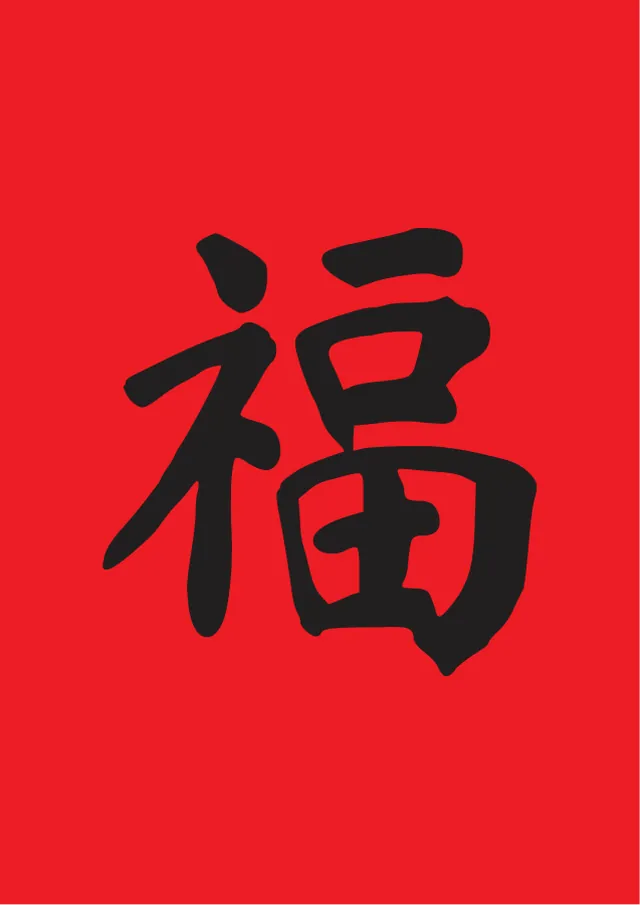
The most-pasted character in the world. In Chinese homes 福 goes on the door for New Year — and very often it goes on upside down.
$8.99
instant download · 54 files
9 typefaces × 3 paper sizes (A4 · A3 · Letter) × 2 backgrounds.
Vector PDF, CMYK, fonts embedded.
Get the files
The meaning
福 (fú) is usually translated as luck, fortune or blessing, but it is closer to “the good that comes to a household”. It is the single most common character in Chinese New Year decoration: on doors, on red envelopes, on the paper that wraps mandarins.
Here is the part visitors always ask about. Walk past a Chinese home in February and you will often see 福 pasted inverted. It is not a mistake. 倒 (dào) means “upside down”, and 到 (dào) means “arrives” — identical sounds. An inverted 福 is a pun that reads out loud as 福到了: fortune has arrived.
That is why this set includes both orientations. Hang it upright for a formal look, or invert it if you want the joke — and the wish — to land.
The blessing every Chinese door asks for.
Before you ask
Will the red look like my screen?
No, it will look deeper. Screens use RGB, print uses CMYK. The red is set to
C0 M100 Y100 K0 — the standard Chinese red — which prints deeper than it glows.
This is normal, not a defect.
Can I print it more than once?
Yes. Personal use — print for your own home, or give prints as gifts.
Which paper?
Red paper gives the traditional look; white paper with a colour printer works too,
since the design carries a full red background. 120–200 gsm card is the sweet spot.
Are the gold dots metallic?
No. They are CMYK gold, so they print as a warm yellow-gold. Real metallic gold
needs foil stamping at a print shop.
Can I use it commercially?
Personal use only — no resale or print-on-demand merchandise.